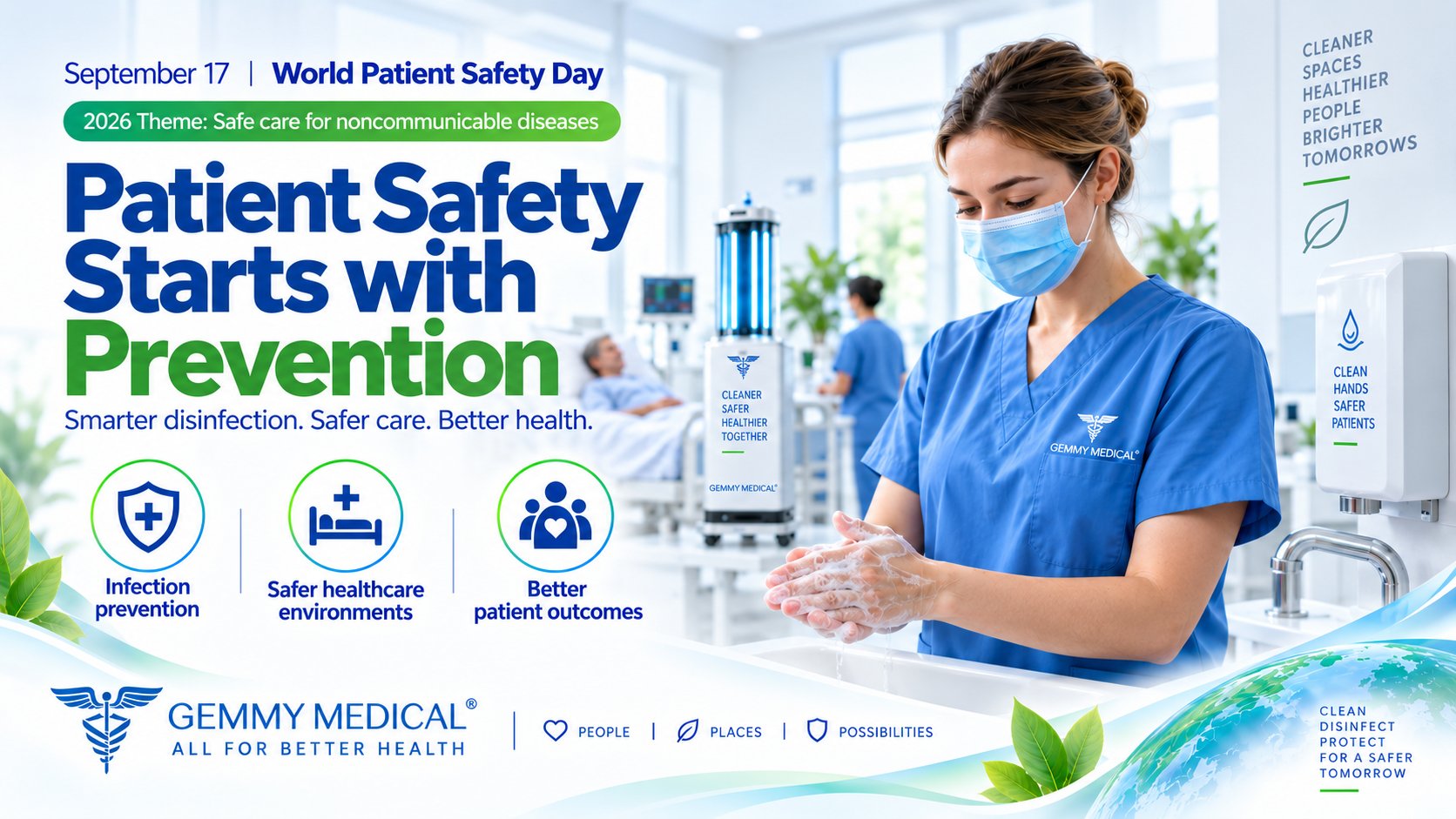
September 17, 2026
World Patient Safety Day is observed every year on September 17 to raise global awareness of preventable harm in healthcare and encourage safer care for patients worldwide.
For 2026, the World Health Organization has selected “Safe care for noncommunicable diseases” as the theme, with the campaign slogan “Safe care for life!”
People living with noncommunicable diseases often require repeated or long-term healthcare across hospitals, clinics, homes and communities. According to WHO, safety risks can arise throughout the entire care journey—from prevention and diagnosis to treatment, long-term management and self-care.
For GemmyMedical, this reinforces an important principle:
Patient safety starts with prevention.
Infection prevention, hand hygiene, environmental hygiene and appropriate disinfection practices are important parts of building safer healthcare environments.
What Is World Patient Safety Day 2026?
World Patient Safety Day is a WHO global public health initiative held annually on September 17.
The 2026 campaign focuses specifically on the safety challenges faced by people living with noncommunicable diseases (NCDs), including cardiovascular diseases, cancers, diabetes and chronic respiratory diseases.
WHO reports that globally, approximately 1 in 10 patients experiences harm during healthcare, with around half of that harm considered preventable. Long-term and repeated interactions with healthcare systems can further increase exposure to safety risks.
The campaign therefore calls for safer care throughout life rather than focusing only on individual medical procedures.
Why Does Infection Prevention Matter for Patient Safety?
Infection prevention is one component of a broader patient-safety system.
Healthcare environments involve continuous interaction between patients, healthcare workers, medical environments, frequently touched surfaces and shared indoor spaces. If hygiene practices are inconsistent, avoidable risks can increase.
WHO identifies healthcare-associated infections among the potential sources of preventable harm experienced by people receiving long-term care.
Effective infection-prevention strategies can therefore include:
Hand hygiene. Appropriate access to hand hygiene facilities and products helps support routine infection-prevention practices among healthcare workers, patients and visitors.
Environmental hygiene. Frequently touched surfaces and patient-care environments should be managed according to appropriate cleaning and disinfection procedures.
Air and environmental hygiene. Healthcare facilities may use appropriate environmental hygiene and disinfection technologies according to their specific risk assessment, intended application and local requirements.
Standardized processes. Clear procedures, appropriate products and consistent implementation can make hygiene practices easier to maintain across different departments and care settings.
The objective is not simply to perform more disinfection. It is to establish appropriate, repeatable and manageable hygiene processes.
How Can Safer Healthcare Environments Support Long-Term Care?
For a patient receiving a single episode of care, safety matters during that interaction.
For a person living with a chronic disease, however, healthcare interactions may continue for years.
That means patient safety needs to remain consistent across hospital visits, outpatient consultations, diagnostic procedures, long-term treatment, rehabilitation, home care and other stages of ongoing health management.
WHO describes this as addressing safety risks across the continuum of care and in daily life.
From an infection-control perspective, this means hygiene systems should be practical enough to operate consistently over time rather than depending on occasional interventions.
From Hand Hygiene to Smarter Disinfection
GemmyMedical focuses on infection control, healthcare hygiene and intelligent disinfection solutions for professional and institutional environments.
Relevant solution areas include:
- hand hygiene
- surface cleaning and disinfection
- professional disinfection products
- air and environmental hygiene
- intelligent disinfection technologies
- automated hygiene solutions
- digital approaches to hygiene management
Different healthcare environments require different hygiene strategies.
A hospital ward, outpatient clinic, long-term care facility or other institutional environment may have different workflows, surfaces, patient populations and regulatory requirements.
For this reason, disinfection solutions should be selected according to their intended application, instructions for use, facility requirements and applicable local regulations rather than through a one-size-fits-all approach.
What Does “Smarter Disinfection” Mean?
Smarter disinfection is not simply the use of more technology.
It means using appropriate products, equipment and processes to make hygiene management more consistent, manageable, measurable and suitable for the actual environment.
Technology can support healthcare organizations by helping standardize repetitive tasks, improve process visibility and support more systematic environmental hygiene management.
However, technology should support healthcare professionals—not replace appropriate clinical judgment, infection-control procedures or established facility protocols.
For GemmyMedical, this principle can be summarized as:
Smarter disinfection. Safer care. Better health.
Patient Safety Requires a System, Not a Single Product
Patient safety cannot be created by one disinfectant, one device or one procedure.
It depends on a broader system involving healthcare professionals, patients, caregivers, facility managers, infection-control teams, appropriate technologies and well-designed processes.
WHO's 2026 campaign similarly emphasizes the need for stronger integrated health systems, a supported healthcare workforce and meaningful participation by people living with chronic diseases.
For infection prevention, the same principle applies:
Products matter, but processes, people and consistent implementation matter as well.
Frequently Asked Questions
What is the theme of World Patient Safety Day 2026?
The WHO theme for World Patient Safety Day 2026 is “Safe care for noncommunicable diseases”, with the slogan “Safe care for life!” The campaign focuses on reducing preventable harm throughout long-term care for people living with chronic diseases.
When is World Patient Safety Day?
World Patient Safety Day is observed annually on September 17.
How does infection prevention support patient safety?
Infection prevention can help reduce avoidable exposure to infection-related risks through appropriate hand hygiene, environmental hygiene, surface management, disinfection procedures and standardized infection-control practices.
Why is patient safety especially important for chronic disease care?
People living with chronic diseases may interact with healthcare systems repeatedly over many years. This creates multiple opportunities for safety risks to occur during diagnosis, treatment, medication management, procedures, long-term management and self-care.
What infection-control solutions does GemmyMedical focus on?
GemmyMedical focuses on professional infection-control and hygiene solutions including hand hygiene, environmental and surface disinfection, air and environmental hygiene, intelligent disinfection technologies and related healthcare hygiene solutions.
Building Safer Care for Life
World Patient Safety Day 2026 reminds us that patient safety is not limited to one procedure, one hospital visit or one day of awareness.
For millions of people receiving long-term healthcare, safe care must continue throughout life.
GemmyMedical will continue exploring practical infection-control products, intelligent technologies and smarter hygiene-management approaches that help organizations create safer and healthier environments.
Patient Safety Starts with Prevention.
GemmyMedical — All for Better Health.
Call to Action
Looking for infection-control, medical disinfection or intelligent hygiene solutions for your market or healthcare project?
Explore GemmyMedical solutions or contact our team to discuss your application, product requirements and cooperation needs.
Sources
- World Health Organization — World Patient Safety Day 2026: https://www.who.int/campaigns/world-patient-safety-day/2026
- WHO campaign event page: https://www.who.int/news-room/events/detail/2026/09/17/default-calendar/world-patient-safety-day--17-september-2026---noncommunicable-diseases


